Thursday, 1 November 2012

Mathematical Tables

By Admin
Uploaded content: Mathematical Tables (Present Value and Future Value Tables)

The tables below are extremely useful especially for finance and accounting students. They are often used to find either the present value or the future value of money. Some academic topics like time value of money and capital budgeting will frequently use these tables to ease calculation purposes. It is highly recommended if you are using all or any one of these, please download it and adjust the picture until it fits into an A4 sized paper before you print it. Also, please keep it nicely for future usage purpose.


Future Value Interest Factors (FVIF) Table 

Future Value Interest Factors Annuity (FVIFA) Table


Present Value Interest Factors (PVIF) Table


Present Value Interest Factors Annuity (PVIFA) Table

Sunday, 7 October 2012

Capital Investment Decisions: Appraisal Methods


By Jackie, Researcher
Topic: Education
Area of discussion: Management & Cost Accounting
Chapter: Capital investment decisions – appraisal methods


The objective of this posting is to share a ‘question & answer’ related to capital investment decision. A real past year question was taken from AAT Stage 3 Cost Accounting and Budgeting. I hope this posting will help more students to understand payback, accounting rate of return and net present value calculations better. Some parts of it might be tricky where it tries to confuse students. Besides, normally professional exams questions will ask a bit on its theoretical concepts or other qualitative measures. Hopefully, this posting will help students to eliminate the fear in exams and to score with flying colours.


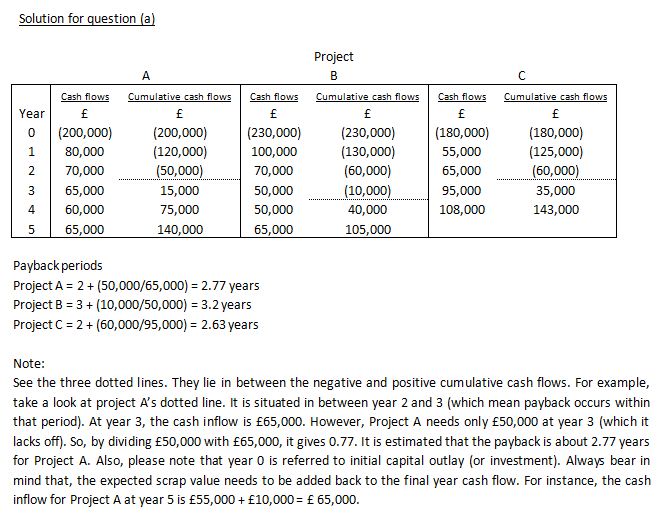
Payback is defined as the length of time that is required for a stream of cash proceeds from an investment to recover the original cash outlay required by the investment. If the stream of cash flows from the investment is constant each year, the payback period can be calculated by dividing the total initial cash outlay by the amount of the expected annual cash proceeds. However, if the stream of expected proceeds is not constant from year to year, the payback period is determined by adding up the cash inflows expected in successive years until the total is equal to the original outlay (see below).


Accounting rate of return uses profits rather than cash flows. Therefore, to find out the profits, we have to take cash flows minus depreciation. Do not add the scrap value back to the final year’s cash flow. This is because scrap value is not profit. Remember, if all things are run accordingly, there will be no ‘gain or loss on disposal’, thus it will not affect the profits. The average investment under this assumption is one-half of the amount of the initial investment plus one-half of the scrap value at the end of the project’s life.


Net present value (NPV) is computed using net cash inflows less the project’s initial investment outlay. A positive NPV indicates that an investment should be accepted, while a negative value indicates that it should be rejected. A zero NPV calculation indicates that the firm should be indifferent to whether the project is accepted or rejected. 


Normally, for the last sub-question of the investment appraisal decisions, the examiners will frequently ask the students on which is the most favorable investment project. Sometimes, when there is a conflict in ranking between the few investment appraisal methods, NPV method will be the key decision factor.


Not all investment projects can be described completely in terms of monetary costs and benefits. There is also a danger that those aspects of a new investment that are difficult to quantify may be omitted from the financial appraisal.


Additional readings, related links and references:

Payback Period: Meaning, Calculation, Example, Usage and Consideration.

Investment Appraisals: A guide to calculating ARR, the accounting rate of return.

Net Present Value (NPV): Tutorials, Calculators, Android Apps, Excel Solutions & Tables for Finance

Watch a short introduction video to Investment Appraisal Methods

Investment Appraisal Masterclass by Kaplan


Friday, 7 September 2012

The Differences Between Financial Accounting And Management Accounting


By Jackie, Researcher
Topic: Types of Accounting (Terminology & Concepts)


The objectives of this research are to find out what are the major differences between financial accounting and management accounting. 


Management Accounting sometimes is also known as 'Managerial Accounting'.

     First and foremost, management accounting is concerned with the provision of information to people within the organization or ‘internal parties’ (i.e. managers inside the organization) to help them to make better decisions and improve the efficiency and effectiveness of existing operations, whereas financial accounting is concerned with the provision of information to ‘external parties’ outside the organization (e.g. shareholders, creditors, tax authorities, regulators, potential investors, and etc). Thus, management accounting could be called ‘internal reporting’ and financial accounting could be called ‘external reporting’.


       Secondly, there is a statutory requirement for public limited companies to produce annual financial accounts regardless of whether or not management regards this information as useful. It must be done as it is ‘mandatory’. Management accounting, by contrast, is entirely optional and information should be produced only if it is considered that benefits from the use of the information by management exceed the cost of collecting it. Thus, it is not ‘mandatory’. A company is completely free to do as much or as little as it wishes.


        Thirdly, financial accounting reports describe the whole of the business whereas management accounting focuses on small parts of the organization such as the cost and profitability of products, services, customers and activities. In addition, management accounting information measures the economic performance of decentralized operating units, such as parts, segments, divisions or departments.


      Besides, financial accounting statements must be prepared to conform with the legal requirements and the generally accepted accounting principles established by the regulatory bodies such as the Financial Accounting Standards Board (FASB) in the USA, the Accounting Standards Board (ASB) in the UK and the International Accounting Standards Board (IASB) to ensure the uniformity and consistency that is required for external financial statements are achieved so that the inter-company and historical comparisons are possible. Thus, financial accounting data should be objective and verifiable. In contrast, management accountants are not required to adhere to generally accepted accounting principles when providing managerial information for internal purposes. Instead, the focus is on the serving management’s needs and providing information that is useful to managers relating to their decision-making, planning and control functions.


     Furthermore, financial accounting reports what has happened in the past in an organization, whereas management accounting is concerned with future information as well as past information. Decisions are concerned with future events and management therefore requires details of expected future costs and revenues. In other words, financial accounting is past-oriented (eg. Reports on 2010 performance were prepared in 2011) and management accounting is future-oriented (eg. Budget for 2011 was prepared in 2010).
               

      In addition, a detailed set of financial accounts is published annually and less detailed accounts are published semi-annually. Management requires information quickly if it is to act on it. Consequently, management accounting reports on various activities may be prepared at daily, weekly or monthly intervals.


Summary


Additional readings, related links and references:

Differences between financial and managerial accounting

The Differences between Financial Accounting & Management Accounting

Financial and Managerial Accounting Information

Financial Accounting Vs Managerial Accounting (Cute cartoon illustration)

Dennis Ensing, CA of WiseMentorCapital, discusses the differences between financial and managerial accounting. Visit StartMeUpRyerson.com for more resources to help turn your ideas into reality.